

 RSS
RSS Apple Podcasts
Genesis 1-3: From Before the Beginning
Podcast: Play in new window | Download
Podcast Introduction
Since it’s Labor Day here in the United States, a holiday, this will be an abbreviated show. And beginning tomorrow, I’ll be switching up the format of the show a little bit. More about that tomorrow.
This is the daily podcast where we will read the *entire* Bible in a year. Stick around, and before you know it, you’ll be able to say you’ve read the entire Bible, in the process, I hope you will be inspired, informed and maybe even entertained.
Today, we are going to read from the beginning, the book of Genesis. Chapters 1 through 3, I’ll give you some of my thoughts on those chapters, and then, there’s the “On This Day In Church History” segment.
Introduction to Genesis
Genesis begins with an assumption. The assumption is that God exists.
How can we know God exists? I know He exists because of how He has worked in my life. I know how I was before I knew Him, and how I am since dedicating my life to Him. I am not the man I would have been if were not for God’s presence in my life.
But there is much more than that. A great many excellent logical and philosophical arguments can be made for the existence of God, which I’ll not talk about here. I’ll leave that to others who are much better equipped to do that. I am more a student of the Bible than a student of philosophy. I don’t discount that field of study, it’s just not where my passions are.
No, the Bible is my source of truth. And Psalm 19:1 says, “The heavens declare the glory of God; the skies proclaim the work of his hands.” And yesterday we read in Romans 1:20, “For since the creation of the world God’s invisible qualities—his eternal power and divine nature—have been clearly seen, being understood from what has been made, so that people are without excuse.” In other words, creation itself speaks clearly of the existence of the Creator. Look at the order of the universe. The intricate detail of all that exists. This kind of order cannot evolve out of chaos. And even if it could, where did the building blocks of the universe come from? The fact that things do exist at all speaks loudly for the fact that there is a Creator. And the order of the universe demands an intelligent Creator.
Genesis is about the creation of the universe, and it’s about the beginning of the nation of people of Israel, and how God has interacted with them throughout history.
It is believed that God used Moses to write Genesis, in addition to the other first five books of the Bible, namely Exodus, Leviticus, Numbers and Deuteronomy.
Genesis is divided into twelve parts, with each part being introduced with the phrase “this is the account of”, or some variation of that, depending on which translation of the Bible you are reading. Each of the twelve sections tells about the life and family of the person named, and the sections, when taken together, tell the story of humanity’s history and God’s plan to restore mankind and our place in His world through Israel.
Thoughts on Genesis 1
Again, because of the Labor Day holiday, I’ll make my comments short today. There are so many events packed into these first three chapters that it’s difficult to decide what to talk about, but decide I must.
So I’ll talk about the first sentence. “In the beginning God created the heavens and the earth.”
Actually, I’ll just talk about the word “God”.
The original language for Genesis is Hebrew. The Hebrew word that is translated as God in nearly all English translations is Elohim, which is a plural word, not singular. Being plural, the pronouns and verbs used with Elohim should also be plural. But they are not. They are singular.
Second century Rabbi Simeon ben Joachi said: “Come and see the mystery of the word Elohim; there are three degrees, and each degree by itself alone, and yet notwithstanding they are all one, and joined together in one, and are not divided from each other.” Adam Clarke, 18th century theologian said: “He must be strangely prejudiced indeed who cannot see that the doctrine of a Trinity, and of a Trinity in unity, is expressed in the above words.” Martin Luther said: “But we have clear testimony that Moses aimed to indicate the Trinity or the three persons in the one divine nature.”
From the very beginning of the Bible, we have evidence that God is a Trinity. Three persons in one. If God is not a Trinity, why would the word Elohim be used?
In verse 26 we read: “Then God said, “Let us make mankind in our image, in our likeness…”
All three persons of the Trinity were present at the creation of the universe: Father, Son and Holy Spirt. God’s plan for mankind was fully developed from the foundation of the Earth. That means that God’s plan for you and for me were fully formed. You and I were on His mind from the beginning. I don’t know about you, but that gives me an entirely new sense of purpose.
Just as we talked about when we read Matthew, and the fact that God waited until just the right time for Jesus to be born, He waited until just the right time for you and I to be born. You are not here by accident or chance. You and I are here to fulfill God’s purpose. Life is precious, beloved. We must not waste it.
Today’s Bible Translation
Bible translation used in today’s episode: Ch. 1-3 NIV
Support
Please remember that this is a listener supported show. Your support of any amount is needed and very much appreciated. Find out how by clicking here.
When you buy through links on this site, we may earn an affiliate commission, and you will earn our gratitude.


This is the award winning podcast where Steve Webb, the O.G. Godcaster and host of the Lifespring! Family of Podcasts, invites you to join him as he reads through the entire Bible in a daily Sunday through Saturday, fifteen to thirty minute show. Each episode features a reading, followed by a short commentary.

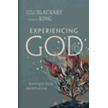 |
Experiencing God (2021 Edition): Knowing and Doing the Will of God By Henry & Richard Blackaby, Claude V. King / B&H Books Experience the book that has restored, reoriented, and renewed millions of people—now thoroughly updated with seven new chapters and dozens of additional stories! Whether you’re reading it for the first time or eager to encounter a fresh edition of the classic text you already love, you’ll not be the same when you finish it. 368 pages, hardcover from B&H. |