

S04E006 – Isaiah 1-6: Who Do You Trust?
Podcast: Play in new window | Download
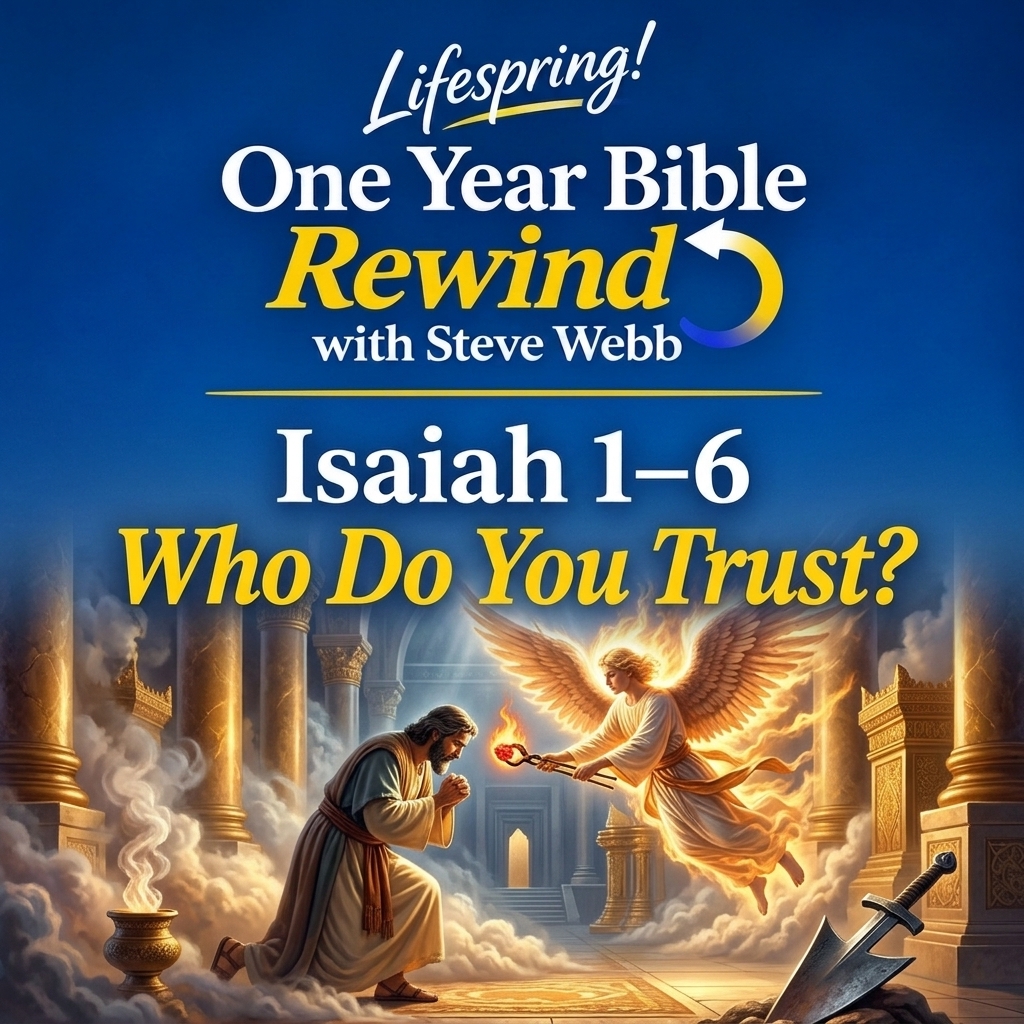
What is a biblical prophet really called to do—and why is the prophecy inscribed on the Isaiah Wall across from the United Nations building in New York City missing its most important context? In this episode of Lifespring! One Year Bible Rewind, Steve Webb introduces the prophet Isaiah and reads Isaiah 1–6, spanning God’s courtroom indictment of Judah’s empty religion, the glorious vision of future peace in Isaiah 2, the Song of the Vineyard, and Isaiah’s awe-inspiring commissioning in the throne room of God.
Today’s Reading
Today’s reading is Isaiah 1–6. You can follow along in your Bible or
read Isaiah 1–6 on BibleGateway.
Commentary
Who Was the Prophet Isaiah? The “Billy Graham” of His Day
Before reading chapter 1, Steve introduces the Books of Prophecy. While we often think of “prophecy” as predicting the future, a biblical prophet is first and foremost a spokesperson who delivers God’s message to a specific people at a specific moment in history.
In many ways, Isaiah was like the Billy Graham of the eighth century BC. Just as Billy Graham counseled twelve consecutive U.S. presidents over a seventy-year ministry, Isaiah ministered for roughly sixty years (from around 740 to 680 BC) with direct access to the kings of Judah and an international perspective. Calling the nation to care for the poor, pursue justice, and return to the Lord, Isaiah warned of coming judgment while pointing ahead to the promised Messiah—the Prince of Peace.
Swords into Plowshares: What the UN Wall Leaves Out of Isaiah 2:4
In his commentary, Steve focuses on the famous words of Isaiah 2:4: “And they will hammer their swords into plowshares and their spears into pruning hooks. Nation will not lift up sword against nation, and never again will they learn war.” Part of that verse is carved into the stone wall at Ralph Bunche Park across from the United Nations headquarters in New York City. Yet since the UN’s founding in 1945, there has scarcely been a single day without war somewhere on earth.
Why hasn’t humanity achieved that peace? Because the inscription leaves out verse 3, which tells us when and how peace will come: when the nations stream to the mountain of the Lord so that He may teach us concerning His ways and that we may walk in His paths. Until Jesus the Prince of Peace returns to reign on earth, human institutions will never eradicate war, because conflict flows from hearts that have rejected God.
Where True Peace Begins—and a God of Second Chances
Even when Jesus came the first time to a world under harsh Roman occupation, He did not launch a political revolution to overthrow Caesar; He came to change human hearts and reconcile sinners to God, commissioning His followers in Matthew 28:18–20 to go and make disciples of all nations. True peace always begins when a human heart turns toward God.
And as we read Isaiah 1–6, we also see the true character of God in the Old Testament: whenever He warns of judgment, He pairs it with a tender promise of cleansing and restoration (“Though your sins are as scarlet, they will be as white as snow”). Far from waiting to strike us down, He is a patient, loving, and forgiving God of second, third, and tenth chances.
Verse of the Day
Isaiah 1:18 (NASB)
“‘Come now, and let us reason together,’ says the Lord, ‘Though your sins are as scarlet, they will be as white as snow; though they are red like crimson, they will be like wool.'”
Even after confronting Judah’s rebellion and hypocrisy in the opening verses of chapter 1, God does not slam the door. Instead, He invites His people to come, reason with Him, and receive a forgiveness so complete that the deepest stain of sin is washed whiter than snow.
Verses We Missed
Sometimes a short passage of Scripture contains more than we can explore in a single daily reading. That’s why Steve also hosts Verses We Missed, a companion podcast that takes a closer look at meaningful Bible passages and details we might otherwise overlook.
Listen to Verses We Missed and discover more of the richness of God’s Word.
Value for Value
In today’s episode, Steve gives a warm thank-you to Lifespring! Family Berean Brother Paul of Seattle for his monthly $20.00 donation!
To learn more about becoming a Lifespring! Berean, Associate Producer, or Executive Producer—or to support the show with any amount of time, talent, or treasure—visit
lifespringmedia.com/support.
Closing Thoughts and Blessing
We would love to hear your thoughts on Isaiah 1–6! Call the Lifespring! Family Hotline at (951) 732-8511, leave a comment at comment.lifespringmedia.com, or email st***@*************ia.com. Tomorrow is Gospel Saturday, and we will read the first two chapters of the Gospel of Matthew.
Until tomorrow, may God bless you richly!